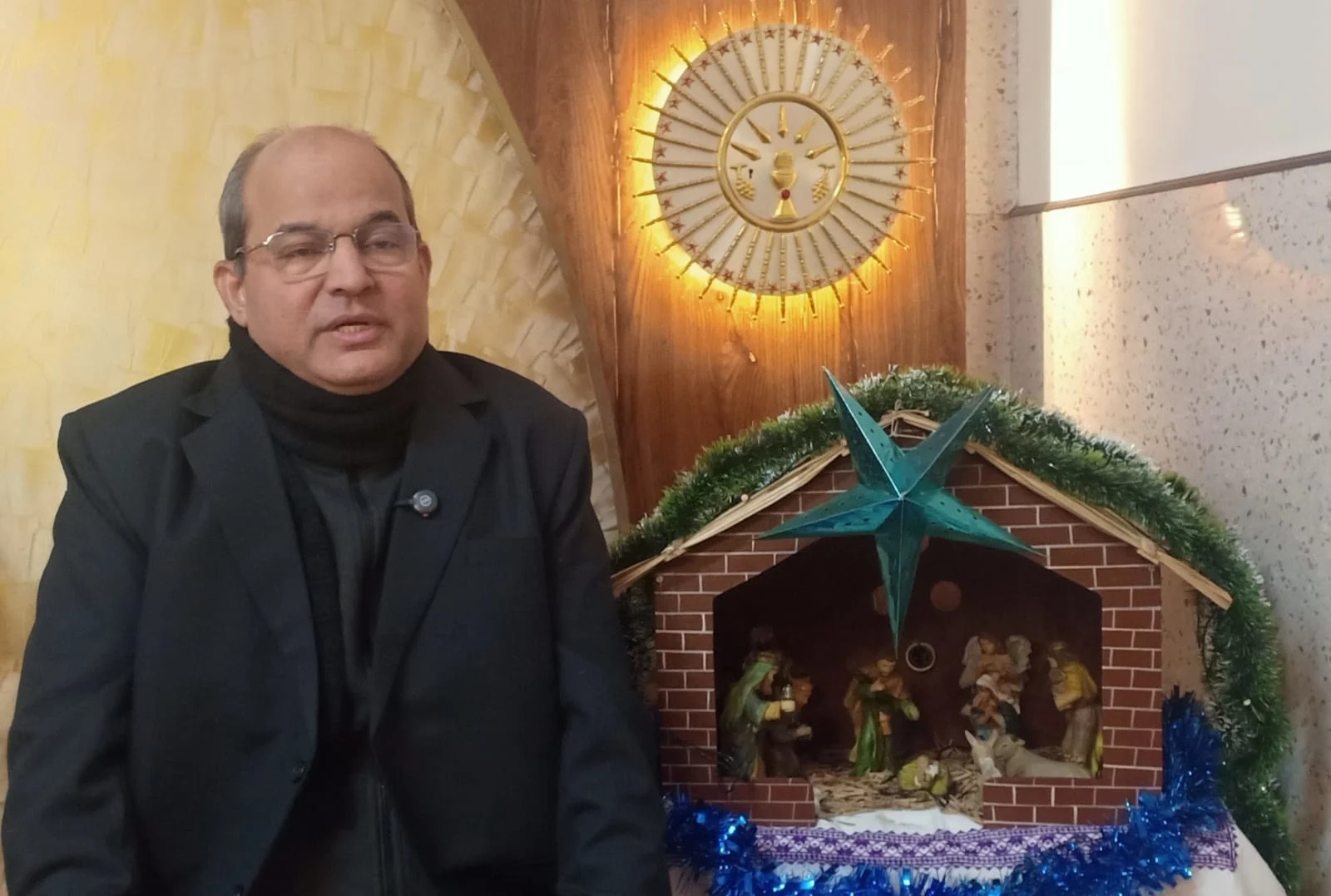
Despite the chilly smog that makes people plead for the right to breathe clean air, and despite threats from certain forces discouraging the celebration of Christmas, Delhi is lit up and longing to rejoice. What makes Christmas so magical? How does it light up hopeless eyes, enrich poverty-stricken households, and heal war-torn countries?
Pope Francis once remarked that Christmas is “a time that reveals God’s pedagogy. God chooses to live among people and to teach them through the language of life and love.”
What is this pedagogy of God?
In the Spiritual Exercises, St. Ignatius of Loyola offers a profound contemplation on the Incarnation. It begins with God’s gaze.
We are familiar with many kinds of gazes, and we name them differently. One that is especially dear to us is the gaze of a mother—watchful, tender, and constant—who keeps an eye on her children despite her worries and work.
A mother’s gaze is a powerful metaphor for the divine gaze. It communicates the height, depth, length, and breadth of God’s love and mercy. The Trinity gazes upon suffering humanity. God gazes upon you and me. But God’s gaze does not stop at seeing. Moved by compassion, God’s Son freely chooses to assume human flesh to redeem all of creation—just as a mother rushes to help her child in need.
Significantly, God chose to be born as a human being in a remote village and into a poor family. This reveals a love that gives until there is nothing left to give. It is love at its very best—tender, vulnerable, unconditional, and immeasurable.
Christmas, then, is not merely the celebration of a historical event. It is a living prototype that invites us to review and renew our lives. It calls us to know God intimately, love God ardently, follow God closely, and become more godly in our daily living.
Shall we allow Christ and Christmas to walk and talk in and through us in our dark and dreary world? May this be our Christmas gift to a weary world.
Happy and holy Christmas to you!
Fr. Jerome Stanislaus D’Souza, SJ, President, Jesuit Conference of South Asia
Pope Francis once remarked that Christmas is “a time that reveals God’s pedagogy. God chooses to live among people and to teach them through the language of life and love.”
What is this pedagogy of God?
In the Spiritual Exercises, St. Ignatius of Loyola offers a profound contemplation on the Incarnation. It begins with God’s gaze.
We are familiar with many kinds of gazes, and we name them differently. One that is especially dear to us is the gaze of a mother—watchful, tender, and constant—who keeps an eye on her children despite her worries and work.
A mother’s gaze is a powerful metaphor for the divine gaze. It communicates the height, depth, length, and breadth of God’s love and mercy. The Trinity gazes upon suffering humanity. God gazes upon you and me. But God’s gaze does not stop at seeing. Moved by compassion, God’s Son freely chooses to assume human flesh to redeem all of creation—just as a mother rushes to help her child in need.
Significantly, God chose to be born as a human being in a remote village and into a poor family. This reveals a love that gives until there is nothing left to give. It is love at its very best—tender, vulnerable, unconditional, and immeasurable.
Christmas, then, is not merely the celebration of a historical event. It is a living prototype that invites us to review and renew our lives. It calls us to know God intimately, love God ardently, follow God closely, and become more godly in our daily living.
Shall we allow Christ and Christmas to walk and talk in and through us in our dark and dreary world? May this be our Christmas gift to a weary world.
Happy and holy Christmas to you!
Fr. Jerome Stanislaus D’Souza, SJ, President, Jesuit Conference of South Asia